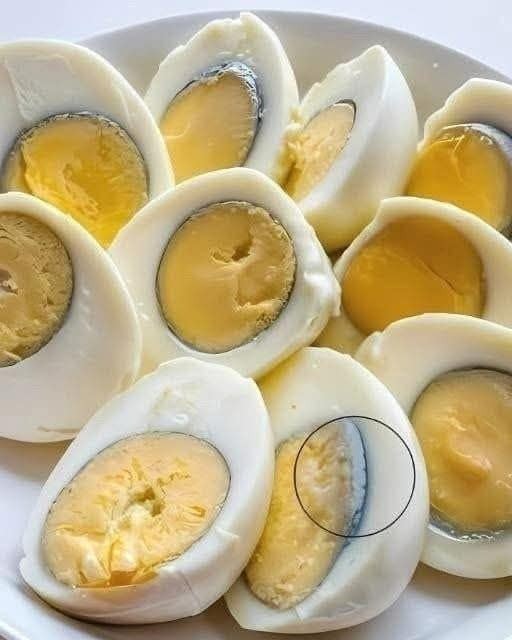
If you’ve ever peeled a hard-boiled egg and noticed a dull green or grayish ring circling the yolk, you might have wondered what went wrong. Was the egg old? Was it unsafe to eat? Or did you somehow “overcook” it? This mysterious green ring has puzzled home cooks for generations, but the truth is far less alarming—and far more fascinating—than most people think. The green ring is not a sign of spoilage or poor quality. Instead, it’s a visible result of a simple chemical reaction driven by heat, time, and sulfur.
🚀 Make Money Online – Up to $50 Per Day!
Let’s break down exactly why that green ring forms, what it means for taste and nutrition, and how you can prevent it if you prefer a perfectly golden yolk.
The Chemistry Inside an Egg
An egg may look simple, but it’s a remarkably complex structure. The egg white (albumen) is rich in proteins that contain sulfur-containing amino acids. The yolk, on the other hand, is packed with fats, vitamins, and iron.
When an egg is heated, its proteins begin to denature—meaning they unfold and bond together, transforming the egg from liquid to solid. This process is normal and desirable when cooking eggs. However, when heat is applied for too long or at too high a temperature, chemical reactions accelerate and new compounds begin to form.
One of those reactions is responsible for the green ring.
Sulfur Meets Iron: The Key Reaction
As the egg white heats up, sulfur-containing proteins release hydrogen sulfide gas. You might recognize hydrogen sulfide by its familiar “rotten egg” smell, though in cooked eggs it’s usually present in very small amounts.
At the same time, the yolk’s iron becomes more reactive under heat. When hydrogen sulfide migrates from the white toward the yolk, it reacts with the iron in the yolk to form iron sulfide. Iron sulfide is a greenish-gray compound, and it deposits itself right where the white and yolk meet—creating that unmistakable ring.
The longer the egg is cooked, and the hotter it gets, the more hydrogen sulfide is released and the more iron sulfide is formed. That’s why the green ring is most common in eggs that have been boiled too long or cooled too slowly.
Is the Green Ring Safe to Eat?
Yes—completely safe. The green ring may not be visually appealing, but it poses no health risk. Iron sulfide is harmless in the tiny amounts formed during cooking, and the egg remains perfectly edible.
In fact, the presence of the green ring has nothing to do with freshness. Even a very fresh egg can develop a green ring if it’s overcooked, while an older egg can avoid it if cooked gently and cooled properly.
The main downside of the green ring is texture and flavor. Overcooked yolks tend to become dry, crumbly, and slightly chalky. The sulfur compounds can also create a stronger eggy smell, which some people find unpleasant.
Why Timing and Temperature Matter
The green ring forms most readily under two conditions: high heat and long cooking times. Rapid boiling causes the egg white to heat aggressively, releasing more hydrogen sulfide. Prolonged cooking gives that gas plenty of time to react with iron in the yolk.
Cooling also plays a role. If hot eggs are left sitting in hot water after cooking, the residual heat continues the reaction. This is why eggs that are immediately cooled in cold or ice water are much less likely to develop the green ring.
In short, it’s not just how you cook the egg—it’s how you stop cooking it.
How to Prevent the Green Ring
Avoiding the green ring is surprisingly simple once you understand the science behind it.
First, don’t overcook the eggs. For classic hard-boiled eggs, bring the water to a boil, add the eggs, then reduce the heat to a gentle simmer. Cooking for about 9–10 minutes is usually sufficient for fully set whites and creamy, fully cooked yolks.
Second, cool the eggs quickly. As soon as cooking is complete, transfer the eggs to an ice bath or run them under cold water for several minutes. This rapid cooling stops the chemical reaction almost immediately.
Finally, peel or store properly. Cooling not only prevents discoloration but also makes eggs easier to peel and helps maintain better texture.
A Visual Lesson in Food Science
The green ring is a perfect example of how cooking is really applied chemistry. Tiny changes in heat and time can dramatically alter the appearance and texture of food, even when the ingredients remain exactly the same.
Rather than seeing the green ring as a mistake, it can be viewed as a lesson in balance. Gentle heat preserves color and texture, while excessive heat pushes reactions further than we want them to go.
The Takeaway
The green ring around a hard-boiled egg yolk forms when sulfur from the egg white reacts with iron in the yolk, creating iron sulfide. It’s harmless, common, and entirely preventable. While it may not look appetizing, it doesn’t mean the egg is bad or unsafe.
Understanding why it happens gives you control in the kitchen. With proper timing, moderate heat, and quick cooling, you can consistently produce hard-boiled eggs with bright yellow yolks and tender texture—no green ring in sight.
