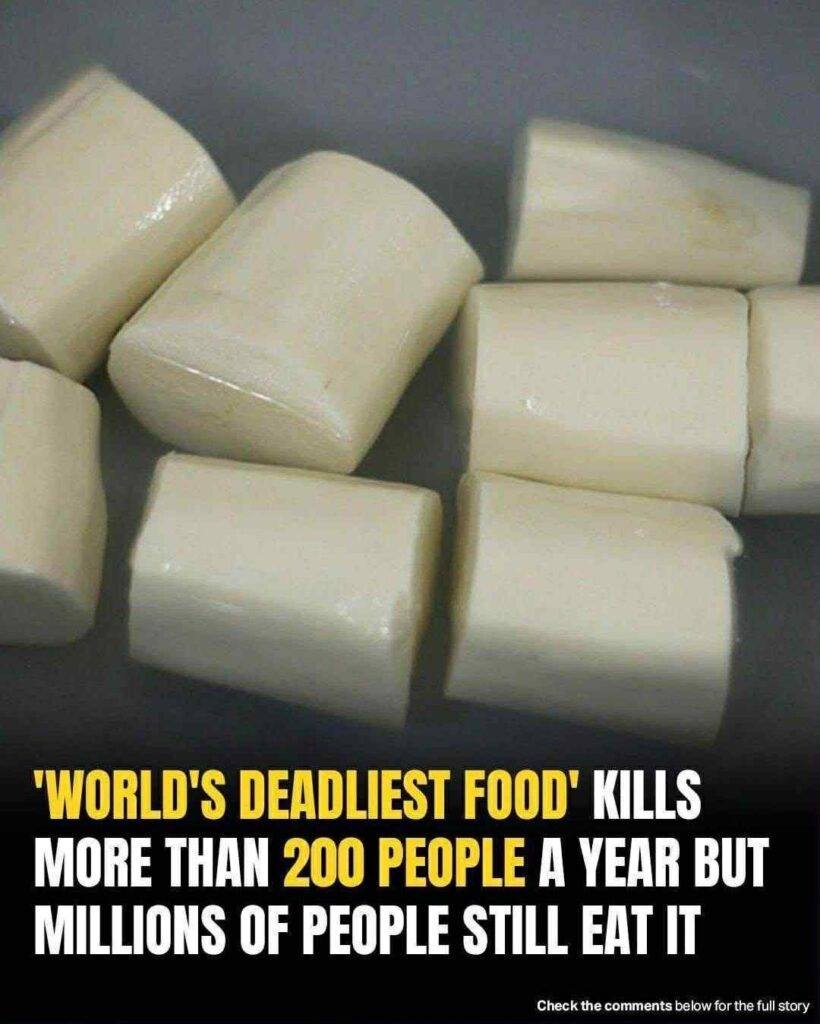
Calling any food “deadly” sounds like clickbait—until you learn about cassava, a starchy root that feeds nearly half a billion people across Africa, Asia, and Latin America. Cassava is a lifeline crop in many regions: drought-tolerant, cheap, and calorie-dense. Yet when prepared incorrectly, it can release toxic cyanide, causing severe illness and death. How can one food be both a daily staple and a genuine threat to life?
🚀 Make Money Online – Up to $50 Per Day!
The answer lies in chemistry, tradition, and survival.
What Makes Cassava Dangerous?
Cassava (also known as yuca or manioc) naturally contains cyanogenic glycosides—compounds that can convert into hydrogen cyanide when the plant is damaged or improperly processed. Cyanide blocks the body’s ability to use oxygen at the cellular level. In high doses, it can be fatal.
There are two main types of cassava:
-
Sweet cassava – lower cyanide content; safer but still needs cooking
-
Bitter cassava – much higher cyanide levels; requires extensive processing
When bitter cassava is eaten raw or poorly prepared, the risk skyrockets.
The Real Human Cost
Health organizations estimate that over 200 people die each year from cassava-related poisoning, though the real number may be higher due to underreporting in rural areas. Thousands more suffer from long-term neurological conditions, the most infamous being konzo—a sudden, irreversible paralysis of the legs.
Konzo outbreaks often occur during famine or conflict, when people rush preparation steps out of desperation. Ironically, cassava becomes most dangerous at the very moments people need it most.
Why Do So Many People Still Eat It?
Because cassava is more than food—it’s survival.
-
Extreme resilience
Cassava thrives where other crops fail. It grows in poor soil, resists pests, and survives droughts. In climate-vulnerable regions, this makes it indispensable. -
High energy, low cost
Cassava is packed with carbohydrates, providing vital calories at a fraction of the cost of grains or rice. -
Cultural tradition
For generations, communities have developed safe processing methods—soaking, fermenting, drying, and cooking—to remove toxins. When these traditions are followed, cassava is safe. -
Limited alternatives
In many regions, there simply isn’t another reliable food source. The choice is not between cassava and something safer—it’s between cassava and hunger.
How Cassava Is Made Safe
Proper preparation is everything. Traditional techniques can reduce cyanide levels by up to 99%.
Common safety methods include:
-
Peeling (cyanide is concentrated in the skin)
-
Grating and soaking for 24–72 hours
-
Fermentation (used in foods like gari and fufu)
-
Sun-drying or thorough boiling
Problems arise when these steps are shortened or skipped—often due to food shortages, lack of clean water, or time pressure.
A Simple, Traditional Cassava Preparation (Educational)
This is not a cooking recommendation, but an illustration of traditional safety principles.
Basic Cassava Detox Method
-
Peel cassava completely and discard skins.
-
Grate or chop finely to release toxins.
-
Soak in water for 48 hours, changing water at least once.
-
Drain and rinse thoroughly.
-
Cook fully—boil, steam, or roast until soft.
Even with these steps, cassava should never be eaten raw.
Modern Science vs. Ancient Knowledge
Scientists are working to develop low-cyanide cassava varieties and improve education around safe processing. But technology alone isn’t enough. In many cases, it’s the loss of traditional knowledge, not ignorance, that leads to poisoning—especially when younger generations migrate or communities are disrupted by crisis.
Cassava deaths are rarely about recklessness. They’re about poverty, displacement, and food insecurity.
Is Cassava Dangerous for Everyone?
In countries where cassava products are commercially processed—such as tapioca, cassava flour, and packaged gari—the risk is extremely low. These products undergo regulated detoxification.
The danger exists mainly when:
-
Cassava is eaten raw or undercooked
-
Bitter varieties are used without proper processing
-
People rely on cassava exclusively, leading to nutritional deficiencies that worsen toxicity
A Food of Paradox
Cassava is not evil. It is misunderstood.
It has saved millions from starvation, fueled entire cultures, and adapted to climates where other crops fail. At the same time, it reminds us that food safety is not universal—it depends on knowledge, time, and resources.
